
The 60/40 Rule for Trailer Weight: What Does It Mean?
What the 60/40 rule really means for trailer weight, why tongue weight matters, and why you should check axle weights on a certified scale like a CAT Scale before and after loading.
· The Trailer Store, Winnemucca, Nevada
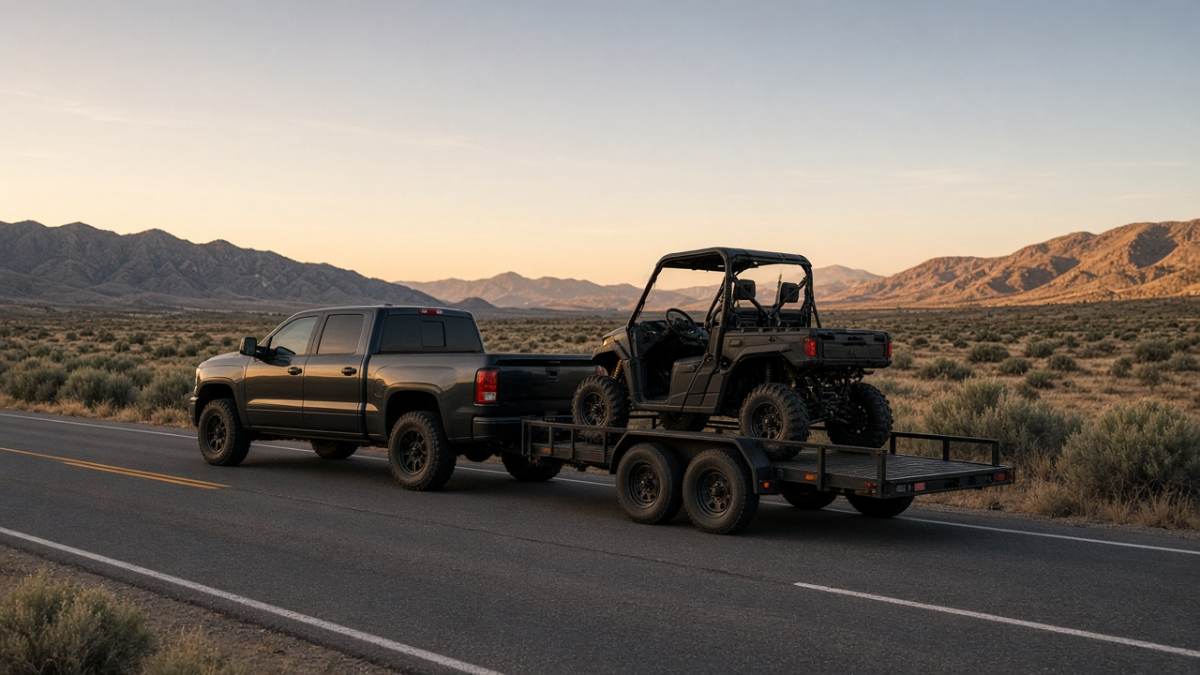
The 60/40 rule is a general guideline. Put about 60 percent of the load in front of the trailer's axle and about 40 percent behind it. The reason is tongue weight.
That is the whole idea. You want enough weight on the coupler that the trailer tracks straight behind the tow vehicle, without so much that you overload the vehicle.
Is tongue weight one number?
Tongue weight is specific to the trailer and the tow vehicle. No single percentage works for every bumper pull and every gooseneck. Always stay inside the ratings in your vehicle's owner's manual and on the trailer's VIN and weight label. Those include the trailer's GVWR, the vehicle's GVWR and GCWR, its rear axle rating, and the hitch and tongue weight ratings.
Too little weight on the tongue is a common cause of trailer sway. When the load sits too far back, the front of the trailer gets light and the back end can push the vehicle around. Too much weight on the tongue overloads the vehicle's rear axle and hitch, and it takes weight off the front tires, which are the ones steering.
Overloading is the bigger problem. A perfect 60/40 does not help if the total weight is past what the trailer or the vehicle can carry. On the trailer, that shows up as bent axles and broken suspension parts. Those are expensive to fix after the fact.
How do you check it?
If you are unsure, visit a scale. This is the only way to know for sure. Weigh the steer axle, the drive (rear) axle, and the overall weight of the truck, both before and after loading, with the trailer attached. Then compare each number to the ratings on your vehicle and trailer.
CAT Scales at truck stops are a good certified choice. They are easy to find, built for exactly this, and the weigh ticket gives you real numbers to work from.
A few other tools can help. Some hitches have a scale built in, and there are scales that measure the ball itself. Those are an added expense, and a certified scale is still the check to trust.
Feel matters too: how the trailer sits and how it rides behind the vehicle. But feel is not a substitute for numbers. If the trailer is not tracking right, stop and take the time to shift the load. If you are not sure, weigh it.
What goes wrong on the road?
People do not usually call to complain about sway. When they do, it is often about an RV. Water tanks, propane, and built-in storage do not move when you brake or turn. The weight stays where it was loaded, which is why you see sway hitches on those trailers.
On a utility trailer you can still move the cargo. That is the difference. If something is not right, you can stop and slide a box or a machine forward. You cannot do that with a full freshwater tank.
Does every load need a different setup?
There is no single rule for how far forward to set the load, because the cargo changes. A side-by-side has its engine in the rear, so that end is heavier. Most people drive them on forward. If the trailer is long enough, backing it on can put the heavy end where it belongs. You have to look at the machine and the deck length.
A gun safe is dense and it does not shift, so center it over the axles. A classic car is a single item, and you know where the mass is. Furniture is the one that trips people up. A move turns into "if it fits, it ships," and the weight ends up wherever the last box landed.
Why is moving the hard one?
If you are packing for a move, load the things you need last first. A mattress can be heavy, but it is often the thing you want when you get there, so it goes on last. The rest is prep work. Rent a dumpster. Donate what you can. Leave behind the two-year-old can of SpaghettiOs. If something is old and you would replace it if you had to use it again, it does not need to make the trip. That keeps the total weight down so the 60/40 has a chance.
Once the trailer is packed, you are not going to unload it to slide a box forward. Get the weight right before the doors close, and weigh it if you can. That is what makes moving the most dangerous version of this problem: you do not get a second try without a lot of work.
What can save you if something goes wrong?
Know how to use your trailer brakes and the brake controller in your vehicle. That is not optional. If the load is not perfect and something starts to go wrong, the brakes are what give you control. Learn them before you leave the driveway.
If you are not sure how your trailer is sitting, bring it by and we will take a look at the load with you. We can talk through the basics, but the ratings in your manuals and a certified scale ticket are what decide what your vehicle can safely tow.
This article is general information only. It is not engineering, legal, or safety advice, and it does not replace the owner's manuals or the weight and tow ratings for your specific vehicle, hitch, and trailer. Every load and setup is different. The driver is responsible for loading and towing within those ratings and for following all applicable laws. The Trailer Store is not responsible for how any trailer is loaded or towed.
The Trailer Store
Winnemucca, Nevada
ttsnv.com